Ratboys Are Sitting in the Calm and Collapse
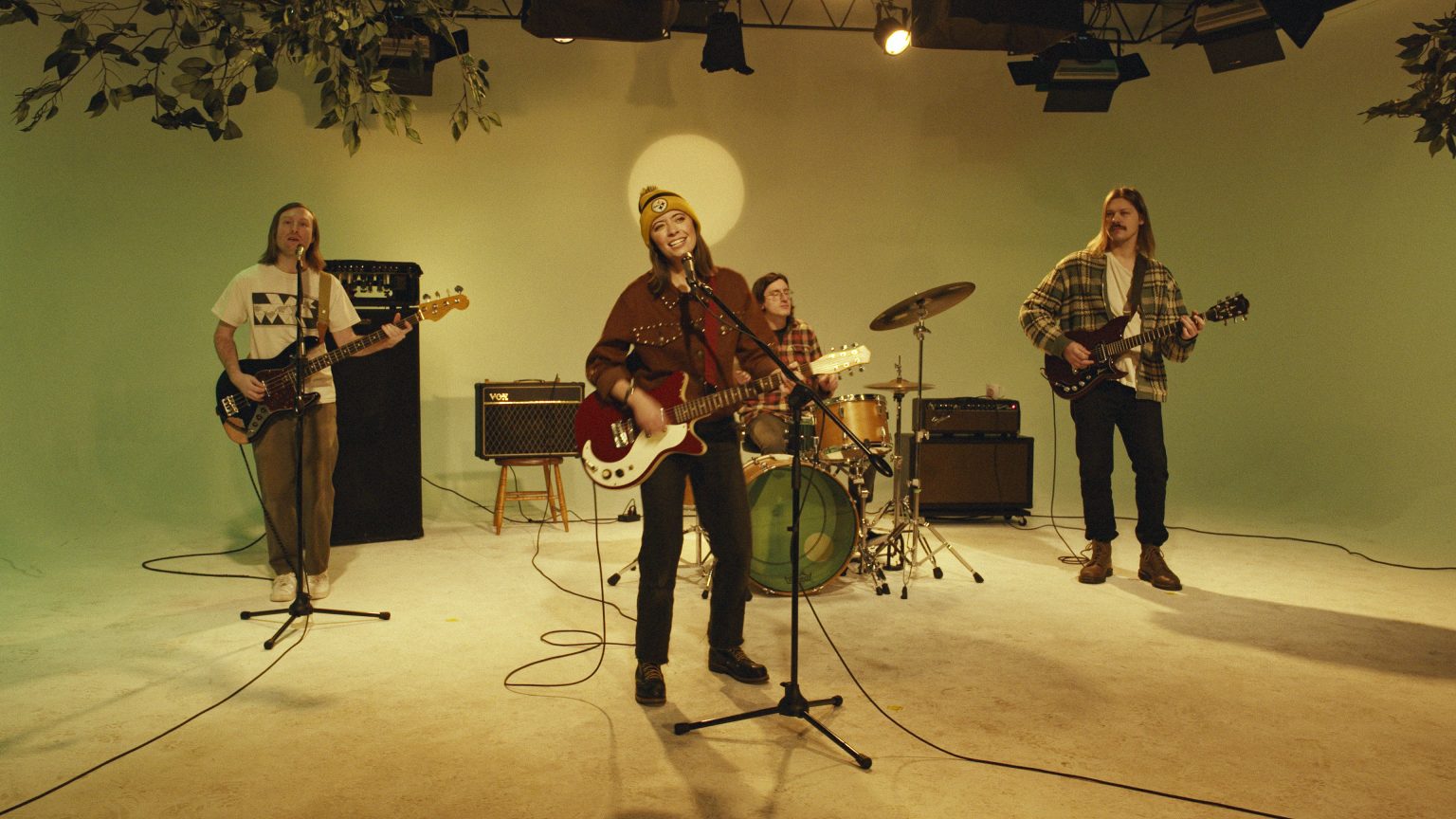
“Well, I know now that nothing’s gonna last.” So Ratboys singer-guitarist Julia Steiner repeats on “The World, So Madly,” a dappled standout from the Chicago quartet’s sixth album and New West Records debut, Singin’ to an Empty Chair.
Though Steiner holds space for this universal truth, she also makes an effort to repair relationships, even if it means confronting a mirror and acknowledging any part she might have played in the way they’ve unfolded.
Ratboys’ latest LP takes its name from a therapy exercise that encourages the patient to speak their unfiltered thoughts to an empty chair in which they imagine the other person in the relationship sitting. The intent is to unlock unresolved emotions or gain newfound perspectives on the past, present, or future state of the relationship or its overall dynamic.
Even for Steiner, who always begins sketching her characters and vignettes from biography, Singin’ to an Empty Chair is her most personal album yet. Staring back at her from the empty chair is an estranged family member who remains unnamed. She envisions the album as an olive branch, a means of updating her relative about her life; she’s even considered mailing them a CD copy with a personalized note.
Ratboys formed as the duo of Steiner and guitarist Dave Sagan in 2010. Since 2020’s Printer’s Devil, the band has blossomed into a synchronized quartet also featuring bassist Sean Neumann and drummer Marcus Nuccio. The foursome went on to team with prolific producer Chris Walla (the former Death Cab for Cutie guitarist whose credits also include classic albums by Tegan and Sara and the Decemberists) to deliver their 2023 breakthrough, The Window. The year-end-list-topping album showcased a band at a new zenith; unforgettable melodies, all-too-relatable earnestness, and notes of Ratboys’ folk-and-country inflected indie rock roots tied a bow around a package of polished, powerful, ripping, locked-in guitar rock.
For Ratboys’ follow-up to The Window, the band once again enlisted Walla, and the result expands their sound even further. Singin’ to an Empty Chair is as musically sophisticated in composition as it is weighty in emotion. Ratboys capture the racing mental and physical tumult of separation anxiety (“Anywhere”) and loss of control (“Light Night Mountains All That”), as well as the placidness of being in the moment and looking around oneself rather than looking into the future (“Penny in the Lake”). The contrast between campfire chill and tailspinning freakouts makes for Ratboys’ most dynamic album yet.
Singin’ to an Empty Chair is a musical manifestation of the tension between two truths: that nothing lasts forever and that one can make an effort to preserve, repair, and grow relationships. Steiner anchors the precarious, destabilizing feeling of hurtling through collapse — the consequence of one-sided efforts to reconcile threatening to tip the balance and send everything crashing to the ground — with the acknowledgement that she’s doing everything she can to control anything she can.
Northern Transmissions spoke with Steiner over Zoom about how her fifth-grade nickname still holds true, fictionalizing the people in one’s life, allowing oneself stillness and grace in a chaotic world, what it means for artists to be in their “ultimate form,” and controlling the controllable. Northern Transmissions: The album’s been out for a week now. Has this week felt different from your other album release weeks?
Julia Steiner: Yeah, a lot of it has to do with the time of year. It’s winter here in Chicago. The last time we put out a record, The Window came out in the summer. We were boppin’ around town and weren’t bundled up. So many of my memories here in Chicago are tied to the seasons. The internet doesn’t have weather; you don’t need to wear a coat to go online, so it’s been nice to get to chat with people all over the place and get their feedback on the record and hear nice things. We’re really grateful to have it out there.
NT: And you had a listening party online the day it came out?
JS: We did one a couple of days before it came out, which was really fun. We did a couple of them, actually. The last few records, we’ve gotten to do these listening parties within our Discord, our sort of fan club community. We did one on Bandcamp, too, which was really great.
NT: Within those listening parties, were there already songs on the album that were resonating with people in ways that surprised you?
JS: It’s hard to keep up [with the comments], but it was a good problem to have. Luckily, we didn’t get any negative comments in those listening parties, so people seemed to like all the tunes.
NT: I read that you had some apprehension about how it’d feel to play these songs live over and over again in public given how particularly personal they are. How much apprehension did you have about engaging with fans who might have their own similar stories to share with you?
JS: I don’t think it’s so much apprehension for my own mental health. It’s hard to explain. That’s the whole point of music for me, is being able to connect with people. The fact that anyone could see themselves in our art and music is so powerful. We do our own merch at a lot of these shows, so when people come and want to chat about the show, the only thing that gives me anxiety about that is it’s an overstimulating, loud environment. I want to be able to really hear people and give them the space to say something. I feel sometimes like I’m not fully able to; you’re churning through the merch line.
I really appreciate anyone who shares a personal story of theirs with us. It’s definitely an odd experience sometimes to have to compartmentalize those things and move very quickly from empathizing with someone, thinking about the story they told you, maybe subconsciously relating it to my own life, and then, boom — in a millisecond, we’re back to, “What size shirt do you want to wear?” It’s challenging, but that’s part of the tour experience. I don’t know how it’s gonna feel with these new ones.
NT: The goal of the album is to update an estranged family member on your life. There’s a line on “Open Up” where you sing, “Bending my back to break the ice.” In most of your relationships, do you find you’re usually the one who makes the overtures? Are you generally the peacemaker?
JS: I think so. Even going back to grade school, I had a nickname when I was in fifth grade or something where my friends would call me Hermes because I would be the go-between of different friends who were fighting. I would be the messenger, the mediator. I do often find myself in that position. Part of it is I like being in control. I find that de-escalation creates a real sense of control for me.
That line — in my mind, sometimes the most innocuous, surface-level conversations can feel really exhausting and taxing just because you’re doing this work to avoid the elephant in the room. Sometimes, the “easy” conversations are actually not easy at all.
NT: Also the effort to get everyone metaphorically or literally in the same room together can also be super-taxing. At least for me, there have been situations where I have to draw the line, like, “It’s on the other person to get in touch.”
On a song like “Know You Then” — the idea of travelling back to the past, whether someone else’s or your own, and trying to understand the early experiences that shape a person — did doing this kind of reflection when writing these songs help you undo any narratives you formed about yourself or the person you’re trying to reach in these songs?
JS: Yeah, probably. I don’t think I’ve fully figured that out yet, which is kind of why these songs feel pretty exciting and alive to me. “Know You Then” is based on this idea of picturing the adults in your life, your loved ones, as children and trying to envision what their experiences must have been like growing up and not just the good times [but] the troubles, too. I’m always searching for a way to humanize the people in my life and get to know them more even outside of a direct conversation. And it’s tough. There’s a lot of family history I don’t know. I want to know more, but I don’t really have this way to get into it, so part of it is me imagining, wondering what it might have been like, filling in the blanks. Like, where does your mind go when there isn’t this connection? That song was a really, really nice mental exercise for me. It’s something that it is ongoing.
I’m deeply on the record of saying I’m not a fiction writer. You can take real people and create your own images, educated guesses, of what their life has been or could be. You can write fiction in the context of real people you know. Some of my favourite art does that. That’s probably as far into the world of fiction as I’m comfortable going at this point.
NT: I think that can naturally happen sometimes. The less interaction you have with someone, your mind will fill the gaps with your own fictions about them or think the best or worst of whatever’s going on with them. You just create this fictionalized version of people you knew.
Kind of on the flipside of the theme of “Know You Then,” where you’re talking about how our early experiences leave lasting impacts on us, jump to “The World, So Madly,” where you ruminate on the idea that nothing lasts forever, but that doesn’t necessarily mean it’s a failure. This idea has been fundamental to how I’ve been moving through the world the last several years. Some people might take it as a reason to not try at all, and I can see how it could be a clear and direct pipeline into nihilism. Do you have difficulty staving off a similar mentality? What keeps you going when you know nothing does last forever?
JS: I come at it from a different place. The idea of saying that [“I know now that nothing’s gonna last”] over and over is more about attempting to make peace with that reality, that change is inevitable. I remember a long time ago reading a poem by Wallace Stevens where he talks about [how] great art, and by extension, everything, must change. And what’s implied is, that will always happen. The idea of constant change is this grand irony that can stress you out sometimes. That song is like my attempt to walk on the path of making peace with that. I get really stressed out about the fact that things change, and you can’t control it, and you can’t go back sometimes. It’s less about giving up or even needing to feel motivated but rather just finding a way to move through the world with this inner peace knowing that things will constantly change, and it’s okay; that’s part of our existence.
NT: And allowing yourself to have a little bit of grace in that moment to just be still and not think about doing anything either way, whether or not it lasts. Also on the subject of reflecting on the past, Chicago’s deep, diverse, flourishing music communities profoundly shaped Ratboys when the band first formed. How has the band’s relationship with the city changed over the years?
JS: There’s been many different phases of our Chicago history. Even thinking about the geography of where we were living, Marcus has had his whole Chicago life before he moved out to the suburbs. I’m thinking of how when I first moved to Chicago, I was living in Avondale in an apartment, and we were practicing in a warehouse, which is what many Chicago bands do. There are these shared warehouse spaces where people get really cheap rent, and it’s really loud and gross but fun.
Some of them are more legit than others. The one that a lot of our friends practice in is called Wright on Carroll. It’s actually a Frank Lloyd Wright-designed warehouse. I think it was a shoe polish warehouse. Don’t get it in your head that it has any sort of architectural significance because of the Frank Lloyd Wright thing. We have a Frank Lloyd Wright book, like a field guide, and it’s in there, and it says it’s one of his least interesting compositions or something. [Laughs] It’s really just a warehouse. That one is super off the grid. Everyone just slips an envelope of cash under the door each month. It’s very low-key.
So yeah, we were practicing there for a few years, and Marcus was living in house venues in Chicago, and Dave and Sean were still living in the suburbs at their parents’ places. Then eventually, our relationship has changed just in the sense of moving to different neighbourhoods, and we started practicing in the house where Dave and I currently live.
COVID was a huge shift for everyone but for us specifically because a lot of the house venues that we pretty much grew up going to in our twenties in Chicago closed or got razed, and now they’re condos. We just kind of aged out of that, too. Nowadays, we’re not going to quite as many DIY shows as we used to; most of our friends are playing in the more established, ticketed venues. But a lot of those venues, thank God, are still around, like the actual established venues that we started going to when we first lived here. That’s something we really don’t take for granted about Chicago. The city has a lot of amazing venues that are accessible to new and young bands.
NT: What does this version of you look like compared to the version who first started the band?
JS: I think we’ve grown a lot over the years in a lot of ways — speaking for myself, in my confidence as a songwriter. We’ve gotten to tour so much and play local shows as well, so we have that muscle memory of what it feels like to be onstage and not just that but to be in venues and in rest stops and on highways. That ecosystem of being a touring band is hard to explain to folks who haven’t done it. It’s just a way of life we’ve become very accustomed to.
In the beginning, we were having these experiences for the first time, so we were wide-eyed and green and just figuring it out as we went, and now we have this aggregate foundation of experiences that we can look back on and learn from and try to do a better job, like being a band onstage and communicating and also running a small business and figuring out how to pack shirts efficiently and make sure the van is running well. There’s so many parts to being a band that go into it, and we like to think that each time, we’re getting a little bit better at doing all those things.
NT: As someone who constantly challenges herself to write lyrics that are more concise and direct, how difficult was it for you to make these particularly personal songs, that are about a specific person, a specific family member, broad? When you wrote these songs, did you think about listeners’ ability to find themselves in the stories, situations, and scenes, or was it more important to protect the identity of the person they’re about?
JS: Definitely. The goal for me is all about balance, having it be open enough that someone can listen to a song and feel invited to create their own images in their mind or really find their own life in the lyrics and the music. Another goal is to ground things in my own experience, maybe not actual memories that I have but my perspective, the words that are coming out of me that are unique to me. I think it’s nice to have some specificity, something to hold onto. For me, that’s kind of that sweet spot of lyric-writing, where there’s enough there to keep you interested and that feels real and human, and then there’s also enough broadness that you don’t feel like you’re reading someone’s biography or obituary. It’s all about striking that balance, and that is challenging. But that’s the whole fun of it. That’s the puzzle of songwriting.
NT: Yeah, like leaving Easter eggs, like the Ringo Starr reference on “Penny in the Lake.” Maybe you could have put a different musician’s name in there, but for you, that’s your guy.
JS: Oh, I love him. Yeah, I’ve been waiting for an excuse to shout out a Beatle in my song for ever, so finally.
NT: Talking about the broadness and people being able to find themselves in the songs— my shock when I learned about the original inspiration for “Anywhere,” written from the perspective of your bandmate’s mom’s dog. Were there any songs where when you found out what the inspiration was, you were just so blown away by how unexpected it was?
JS: One that comes to mind right away is another pet origin story. I love the band PUP. They’re some of our close friends, and Stefan [Babcock]’s one of my favourite songwriters. They have a song called “Sleep in the Heat” which is about his pet chameleon. I think his name was Norman, and it was kind of a eulogy of mourning Norman. If you look at the lyrics, it is one of those where you wouldn’t necessarily know it’s about this pet lizard, but once you know that, it’s doubly heartbreaking. We toured with them, and we were playing a show in Pittsburgh, and their merch manager Steph pulled me aside and was like, “You know this one’s about his dead chameleon right?” And I was like, “What!?” I heard it new for the first time, and it blew my mind. They have a lot of songs like that where they’re based on very specific memories, but they have so much life outside of those exact details. Stef is a big inspiration for me there.
NT: You mentioned about “Light Night Mountains All That” that you love the idea of putting out a song that does not sound very reflective of the overall album, and it’s kind of a red herring. Do you recall any songs that were a huge red herring for you where when you listened to the album you were totally thrown off by the single?
JS: This wasn’t necessarily a single, but it kind of threw me off a little bit. Geese — their record 3D Country — track one on that record [“2122”] is psycho. It starts with just the singer [Cameron Winter] going fucking full-tilt with nothing else. It’s like an a cappella, really visceral, close, dry vocal. When I first heard that, I was like, “What? Is this what this band sounds like?” I was completely confused in a quite exciting way. And it was funny ’cause I remember our friend who showed us that record for the first time was like, “Just get through the first song. Keep going.” And we did, and it’s an amazing record. I just remember feeling so disoriented going into that album. But it’s a powerful track one. He’s not screaming. He’s kind of yelping. It’s very intense vocal stylings that don’t sound like singing. It’s pretty out there and very exciting. Lots of energy.
Another one I’ve been thinking about lately is Black Midi. I heard one of the Black Midi songs one time, and it’s one of the ones where Geordie Greep is truly speaking in tongues, like I have no idea what’s happening. For a minute there, I didn’t feel compelled to dive into the Black Midi catalogue, ’cause I was like, “Okay, this is what this band sounds like. That’s cool. I’m good.” But then I listened to their first record a couple of weeks ago, and it was just so beautiful. Obviously, he does kind of go pretty far out with his vocals consistently, and there’s just a lot musically that was really pretty delightful and not abrasive. I’m sad it took me so long to listen to them for real, but I’m really liking it.
NT: On the topic of bands that really stretch and try different things, on Empty Chair, there are a lot of more jam moments, like “Light Night Mountains All That,” for example. It seems like a lot of the commentary about Singin’ to an Empty Chair is saying this album is Ratboys in their peak form or their ultimate form. To me, that always comes off as not quite the compliment the speaker thinks it might be; to say something is in its ultimate form sounds so final and discounts any room for growth. How do you feel about it?
JS: Maybe I’m guilty of something similar. I often tell our friends, “You’re at the height of your powers! You have hit your stride!” I think that isn’t necessarily a bad thing. Just because you’re at the height of your power doesn’t mean you can’t stay there. That’s where our goal is, is to constantly just keep making music. In a perfect world, we’ll have more to say, and I think we always will.
It’s really hard for me to understand how Ratboys’ albums relate to each other. For me, they spring from the time that we made them and who we were and what kind of music we wanted to play. I try not to think too much about the ups and downs musically. It feels very much just like charging ahead. So that’s the plan, to keep doing that, just push it forward.
NT: Related to all this, can I tell you how it reminds me of John Cena?
JS: Go for it.
NT: I heard you talk about Ratboys’ ambitions to make a living off of the band without expecting to go viral or worrying about anything that’s out of your control, and one of John Cena’s mantra is, “Control the controllable.” I heard him say that once, and it’s lived rent-free in my head for a few years now. With some of the songs [on Singin’ to an Empty Chair], like the first couple especially, and your feelings about the ambitions with the bands, it seems like that’s also the mentality: just control what you can and don’t worry about anything else.
JS: Yeah, pretty much. I’m grateful we can control a lot. We have total control over the music, and we haven’t been pressured to do things we don’t want to do. We feel very much in command of our own ship. Maybe John Cena’s on to something, man. He’s a wise fellow. But yeah, that’s it, man. I live for that shit. I love control. [Laughs] I’m always trying to keep that in mind.
NT: Is there anything in particular you want people to get out of Singin’ to an Empty Chair when they listen to it?
JS: I’m just really grateful for anyone who presses play, specifically to the whole album. We put a lot of love into the order of the songs. It’s very intentional, so it means a lot that anyone else on this planet is still a full-album listener. That’s my preferred format of listening to music, so that’s how we intended this one to be heard, and it’s so awesome that it’s out now. I just appreciate people spending time with the music, and we’re excited to play these songs live. It’s gonna be a really great time.
Order Singin’ to an Empty Chair by Ratboys HERE
Latest Reviews


Tracks

Advertisement
Join the Northern Transmissions insiders list
Sign up for reviews, interviews, news, videos, playlists — and more.