Maruja Turn Their Heads on The Rules of The Game
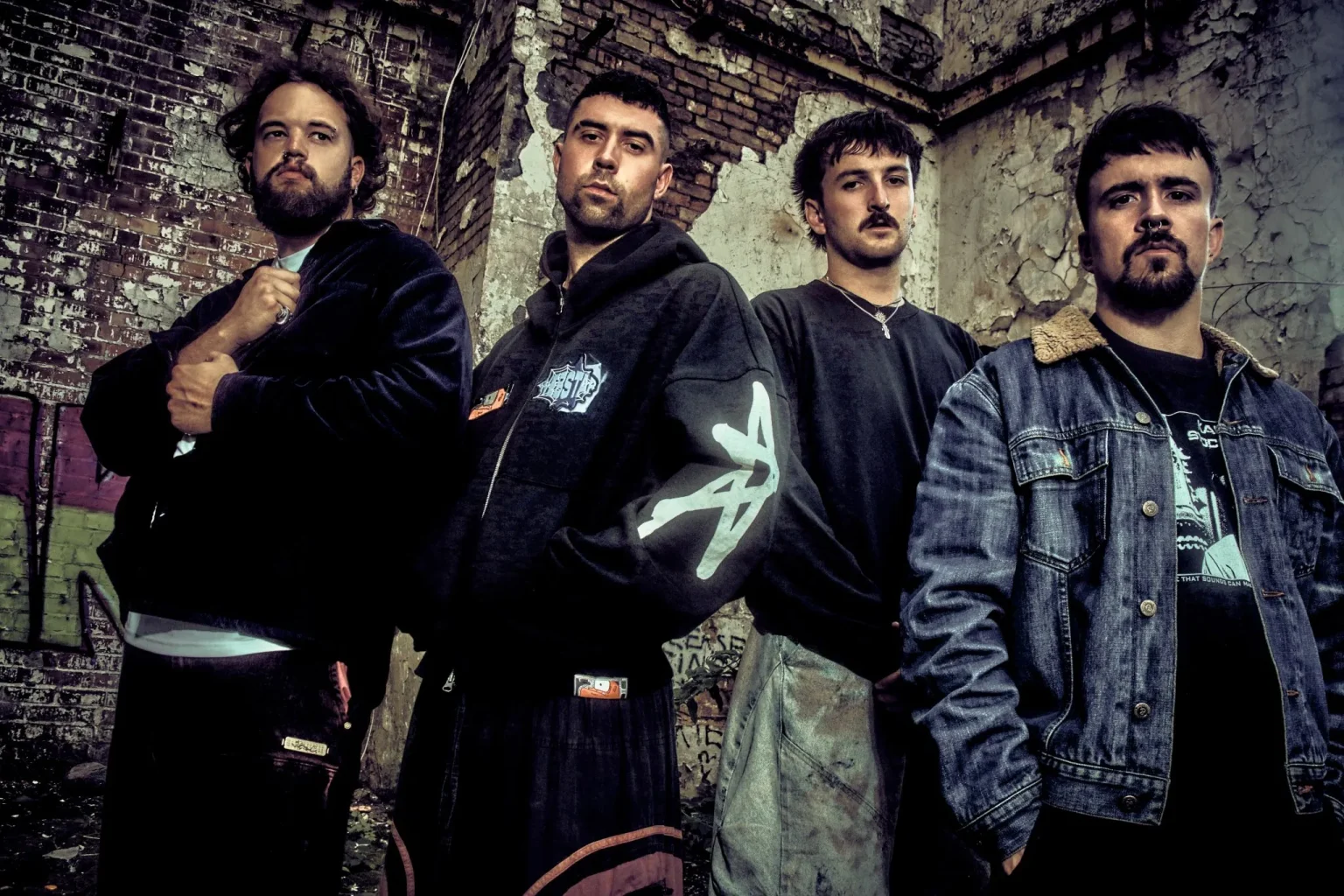
Maruja, the Mancunian quartet, diligently learned the rules of music and turned them on their head. Harry Wilkinson, Joe Carroll, Matt Buonaccorsi, and Jacob Hayes attended college together and headed for consortium, but an emphasis on form came at the expense of unspoken chemistry and lessons on music’s cultural impact. Their grueling hodgepodge of jazz and hip-hop, plus blistering lyrics indicting the UK government for generations of war crimes, fundamentally decries the hierarchical institutions that brought the members together.
Their debut album, Pain to Power, released last year on Music For Nations, is a white-hot amalgam of class warfare and sonic touchpoints from their past EPs. Each track stems from improvisation and “flow states,” then blossoms into messages of solidarity and hope. Drummer Jacob Hayes emphasizes the importance of offering hope and solutions, rather than simply following a lineage of artists who bemoan the political system without meaningfully combating isolation. Through dynamic live shows and the communal construction of each song, achieved through what they describe as a “flow state,” Maruja offers an urgent antidote to individualism.
Northern Transmissions: You met your bandmates in college and grew to love improvisation out of spite for strict music teachers who stressed formalism. While in school, did you learn anything about music’s role in protest, politics, and culture? If so, what stood out the most? If not, what felt missing from your music education, and how did Maruja help you find it?
Jacob Hayes: Music education lacked any exploration. Our curriculum focused on exams or on how to construct a song for grading. All of us found it boring and restrictive. A lot of our biggest musical heroes have done things distinctly their own way. Naturally, that inspires you to seek the new and exciting while remaining confident in forging your own path.
We’d always be jamming at rehearsals, but when the band grew to 4 in mid-2019, we started focusing on improvisation as a vital skill to hone. We spent relentless hours throwing ideas at the wall, going to shows, getting inspired, and researching music history for ourselves, which expanded our musical knowledge to where it is today. As we weren’t taught music beyond secondary school, we’ve continued to grow and expand our songwriting through our own lens. We have a lot of documentaries and YouTube videos to thank for this.
NT: You draw inspiration from both the British jazz and post-punk scenes, as well as the narrow yet flourishing intersection between them. What insights have you gleaned from your involvement in these different communities?
JH: A lot of our approach to songwriting changed around 2018/2019, specifically when we took to improvising in a serious way. For a long time, we felt like outsiders in Manchester. Growing up trying to play weird genre-blending music with a sax was met with a lot of difficulty and friction. The hangover of 80s/90s/00s Manchester indie scene was a plague that spat out insipid copycats that were only a few terrible lyrics away from being an Oasis covers band, so finding music that came from the UK that was similarly influenced by acts from overseas was amazing.
It was insanely inspiring to know there were other young people making a name for themselves, playing the weird music we were experimenting with in our rehearsal room. Hearing about The Windmill in Brixton hosting all these weird new bands week in week out, selling them out was crazy to hear, as we didn’t have a venue like that, the bands like that, nor the audience ready to listen to any of that.
We still feel like outsiders in either scene. The biggest artists doing UK jazz & post-punk are from London or down south, and we don’t really know any of them either. We’ve got maybe more similarities to jazz bands outside of London, like GoGo Penguin, Portico Quartet, Mammal Hands, who were making electronic-inspired jazz music – something we tried to do but with rock instrumentation. We don’t really sound them either.
They also feel like a generation before ours, whereas acts like Enola Gay, Gurriers, Lambrini Girls, Big Special, Opus Kink, Nerves, Scaler, and The Scratch have been on similar musical journeys to us and share a similar timeline. We’re all putting out our debut albums around the same time and feel more connected than acts from 2018/2019. Manchester’s now got a really cool, interesting scene. There’s no central venue, label, or sound necessarily, but that’s what makes it. Check out: Dove Ellis, Westside Cowboy, Slap Rash, Zdenka, Tesni, TTSSFU, GoGo Penguin, Jasmine 4.t, Elf Traps, Yaang, Shunya, Catbandcat, and Mandy, Indiana.
NT: When writing Pain to Power, how’d you ensure sonic and narrative cohesion without stifling the creativity that comes from messing around?
JH: We wrote the majority of the album this past January and February, the same window of time we had to record, mix, and master everything. Time was definitely against us, which perhaps forced us to be slightly restrictive in experimentation, but confident in our choices. We’d jam around ideas we’d had from last year and push them to a point where they felt fresh, weird, but strong.
We’d already written two pillars of the album before this process began – “Born To Die” and “Look Down On Us” – so we used those mammoths as points of reference, but honestly, it came naturally. We’d been gearing up for this album, having dropped 3 EPs in just over two years, as well as mountains of insane improvs from these periods. We wanted the album to flow naturally, so we stuck to the same proven formula from these projects.
After recording some jams in the studio and analyzing the tone and feel, Harry writes lyrics. What’s the process of extrapolating a meaning or story from a session? Does the whole band participate? How do you resolve disagreements over the direction to go in?
Before a lot of jams, we talk to each other about how our lives are going. For example, difficulties with family, greater issues happening around the world, etc, the nature of that topic tends to bleed heavily into the emotion of that jam. “Look Down On Us” came from a jam in the spring of 2024, not long after we all returned from time away. We’d all been independently taking an interest in particular writers and commentators discussing the global political shift, analysing the Overton window drifting further to the right — what was occurring in the US presidential race, the UK election, and world events happening during this period.
This shift became an obvious topic for us to write about. The sonics of that jam, and subsequently the full song that emerged from it, allows for space to talk about both the brutal aspect of the world and to offer a resolve for peace in the latter half.
Harry sometimes chats with us about wanting to address a particular topic or is inspired by a conversation we have, either as a group or one-on-one. It all varies, but always feels appropriate. For the album, we had very little time, so Harry would either bring lyrics that he’d previously written and try them over an instrumental passage or would write after a full day of jamming. The rest of us would offer our opinions on certain moments, but it felt quite clear when we should revisit something, not that it happened much.
NT: What did you listen to while writing Pain to Power? Does it show?
JH: A lot of Maruja jams. Last year, we dropped an album of old improvised pieces, The Vault (available on Bandcamp & YouTube only), which is a selection of our favourite jams from 2021-2023. We never had time to make these into actual songs, but we used to listen to them all the time in hopes of doing so.
The jams from 2024-present are very different in tone, with some serving as the basis for Pain To Power. We thought it would be nice to show people what some of the raw starting points sound like and the musical journey we’ve been on, which normally wouldn’t see the light of day. Hopefully, next year we can revisit some of the new wild and insane jams to begin writing album 2.
The tail end of 2024, we smashed out a massive 50 date tour across Europe, so when we weren’t playing, it was a real mix of stuff we were listening to: Knocked Loose, Fabiano do Nascimento, Kublai Khan TX, Doechii, Kendrick Lamar, John Francis Flynn, Show Me The Body, Lankum, NYOS, Nala Sinephro, SOPHIE, Lelio Littazzi, Rosinha De Valença, Chat Pile, Death Grips, Colin Stetson, Miłosz Pękala, Pharaoh Sanders, Turnstile, Alice Coltrane, Little Simz, Swans. Definitely missed a lot, but you get the idea. The few times we’ve looked at other artists in the studio are usually when we’re in production mode. We love when bands use bass drops, which we added when we finished Break The Tension back in 2023, and then at the end of Born To Die.
NT: You’ve talked about entering a “flow state” when trying to write a song. How do you get there?
JH: Again, going back to this pre-pandemic era of the band when we were playing 20-30 hours a week, mostly improvising, together in these grim, hellish rehearsal spaces in and around Manchester. That was the first time we ever experienced flow state. We’d get into our studio, run the set to warm up, and be ready for whatever show was next, then start riffing on something. When we got more comfortable doing this, we’d kill the lights, turn on a lamp or two, and really sink into this weird liminal space we’d created.
When you first start jamming, you look for cues, observing each other to catch when changes might be happening. Killing the lights hyper-focusses on the sonics. Any slight minute change one of us made would signal to the others. Reaching flow state is when we’re all changing and synchronising our parts simultaneously without looking or speaking to one another. The change has happened, but no thought was given to it. All of a sudden, an hour has passed; you remember nothing and feel exhausted yet liberated.
We may repeat this pattern a few times a day, multiple times a week, and, after years of practicing like this, we’re suddenly able to slip into this state of mind seamlessly. As mentioned previously, The Vault is a record of this. “Breaking Inertia” has been one of our favourite jams for a long time and is a great example of one complete jam start to finish. We press play on a shitty old phone, start playing, black out, then emerge out the other end, however long later to discover we’ve created a gem. It’s a beautiful, spiritual, and cathartic experience to create music this way.
NT: You’re neither the first nor the last band to berate late-stage capitalism and the corrupt politicians who profit off our despair, primarily through the lens of British imperialism. What makes you different?
JH: In our previous EPs, we’ve discussed these topics, but we wanted to make a conscious effort to be more obvious with the album. This felt essential, as we also saw another element essential to countering this narrative. A lot of contemporary artists have anger and oppose late-stage capitalism without offering much hope or a formative solution. There’s so much despair and isolation, particularly for people our age. We felt offering that balance was something nobody else was doing.
NT: Something unique about bands from the past 10-15 years that create explicitly political music is the proliferation of social media. None of the issues you sing about are new, but we can view these atrocities 24/7. Did this omnipresence inform your songwriting or narrative structure?
JH: For sure. You can’t ignore or hide from it. Something we find bizarre is how these global atrocities are so immediately accessible from your pocket, yet how long it takes or how little people (with platforms specifically) are talking about it. Certain artists or notable celebrities have chosen to ‘say nothing’ on the state of what’s happening, yet decide to take money or work from corporations that fund death in a weak attempt to remain ‘non-political’. We believe it’s the artist’s job to speak up and voice the voiceless when media and government control are so biased and untrustworthy. Obviously, we don’t expect everyone to call out government corruption, but in previous generations, you’d see everyone from Michael Jackson, Sade, the Rolling Stones, Nina Simone, and The Beatles, to name a few, talking about necessary political issues. When did that change?
NT: Last year saw swathes of ‘non-political/politically neutral’ podcasts feature Donald Trump on their platform without offering the same privilege to the political opposition. This is not just being complicit but actually advocating and promoting a tyrannical campaign that fuels the death of millions. Watching this happen last year has strengthened our confidence; we know what we’re doing is right. We watch much, much larger platforms ignorantly neglect their responsibility.
JH: The dichotomy of major celebrities facilitating and engaging in fascist rhetoric for views whilst remaining ‘neutral’ is growing. It’s more important than ever to use whatever platform forged to displace these narratives.
NT: What’s your relationship with social media? Did creating this album change your relationship to it?
JH: We’ve tried to distance ourselves as best we can and read as much as from print journalists to avoid the madness of social media. We’ve been distancing ourselves – with half of us completely off them – over the past few years. It’s important to stay engaged with the community, but away from the evil of these algorithms. It’s a hard line to balance. The truth is, we’ll not know the true consequences of how we’re impacted by social media until permanent damage is done. It feels like we’re going through a particularly brutal period and have been for a while. Who knows when, or if, that’ll end.
NT: How do you decide when a song ends?
JH: This changes between each track. Sometimes it’s super obvious, like with Bloodsport – everything just fell into place. Sometimes it keeps changing. We like to have a song gig ready and play it a bunch of times before hitting record to fully flesh out the nuances, which is our favourite approach. Sometimes, a song doesn’t necessarily finish getting written, like with Resisting Resistance, which is now nearly double the length when played live.
NT: When your songs are born from collaboration and intuition, how do you resolve conflict in the studio?
JH: All songs are collaborative. Again, this is quite natural. We’ve been writing our way for so long that it all requires trusting each other’s judgment and feeling it out. If someone has another idea, try it out. If we prefer it, we run with it. If not, we go back a step—trial and error. Simple really.
NT: How do you ensure that each member plays a role in making decisions?
JH: The whole songwriting approach is collaborative, from the improv jam as the foundation to building structures around a particular phrase; it’s just talking and allowing each other’s ideas to be tried out. We rarely tell each other what to play. That’s the beauty of jamming as much as we do and having that as the foundation. Most of our parts have already been written for us in that initial jam.
NT: What song do you think is the thesis of Pain to Power?
JH: “Look Down On Us”
Order Pain To Power by Maruja HERE
Latest Reviews


Tracks

Advertisement
Join the Northern Transmissions insiders list
Sign up for reviews, interviews, news, videos, playlists — and more.