7.8
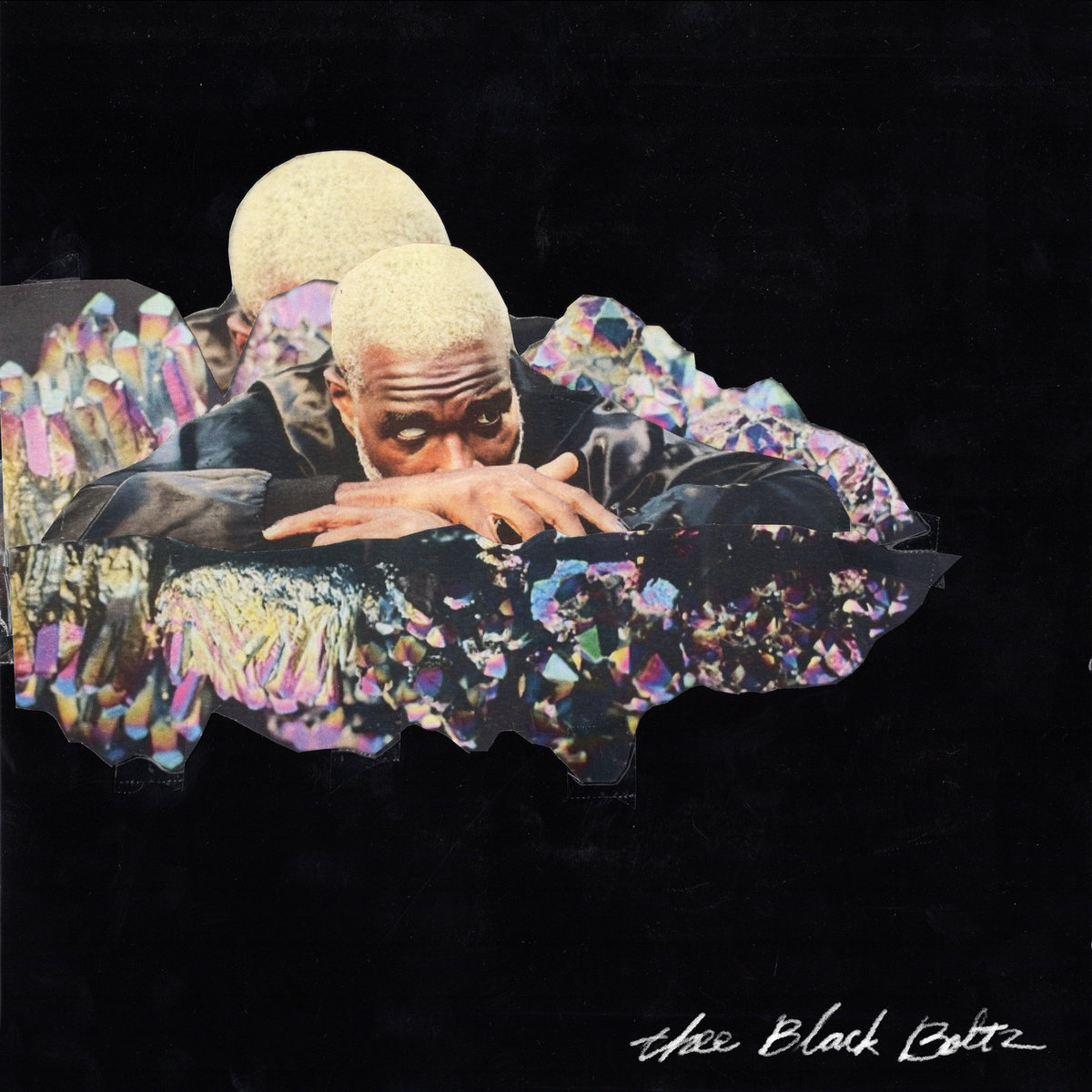
Thee Black Boltz
Tunde Adebimpe
After becoming a trailblazer in the New York art rock scene, TV On The Radio’s Tunde Adebimpe marks his solo debut with Thee Black Boltz. He likened the title and concept of the record to the electricity within a storm cloud, charging up amidst a chaotic rumble before pointedly and sharply striking the ground. It promised both turbulence and resolution, a way of seeking order, clarity, and relief from the exhausting ordeals of life, work, relationships, and personal identity. Thee Black Boltz delivered in this regard: in the moments of emotional turbulence, Adebimpe’s industrial, futuristic, electronic beats buzzed with an unceasing energy that beams into space. On the contrary, Adebimpe’s moments of certainty, often marked by simpler declarative maxims and absolutes, “return to Earth,” in a sense, experimenting with quieter, more intimate, acoustic sounds.
Adebimpe begins his debut record with a spoken-word poem, which sounds much like an archived radio program’s introduction recorded in the bygone Space Age era. It doesn’t take much analysis to realize that it functions as both the moral and roadmap of the following story. “Just when things got darkest, / a thought!” the robotic voice utters, charging up the first spark that will later build into a bolt, while the static whirrs behind it. The voice continues later on, “Say we start in the stars / Descend to the mountain / Walk down and through the hillside towns / Settle our love and hate affairs / Walk down through the wood to the edge of the brook / Sit and lament some happy-sad run / At the base of the mountain turned…” Like a literal path of lightning, the following tracks mirror this established trajectory. There are, at first, the pumped-up rock tracks “Magnetic” and “Ate the Moon,” whose electronic frays and constant hums keep the songs’ momentum going. Then the record’s midpoint grinds to a halt with “ILY,” a lulling, acoustic guitar-based song that’s refreshingly simple and sweet, taking a brief three minutes to acknowledge a profound and meaningful relationship. The energy shoots back up again with and begins “The Most,” finally returning to the sky with the celestial-inspired finale, “Streetlight Nuevo.” Even if not intentional, Adebimpe’s selection of songs, especially in the order that they’re in, demonstrate his solid sense of concept.
Yet, aside from trying to capture lightning through music, Tunde Adebimpe uses Thee Black Boltz to explore exhaustion—how it clouds one’s progress, how it causes friction and slows a person down, and how it distorts the way we see other people. In some songs, these references are more direct. The line, “He’s reeling through the crowds / And he moves like / No control / Crushing till there’s nothing but sand and stone,” in “Ate The Moon” gives an extreme visual of never-ending movement, demonstrating its literal destruction for this almost-Sisyphean goal to keep the energy alive and churning, mostly through a dark, clunky industrial beat and haunting choral arrangement comprised of children’s voices. “Drop” ponders death, and whether our bodies will feel all the weight they’ve exerted while they were alive, yet that “lightning strike” of creativity inspires us to keep working.
Yet, the subtle nods to exhaustion become the most exciting. One of the most lyrically interesting songs is “The Most,” which, upon first listen, seems like it’s about a typical, turbulent relationship. “We glide / Through phases, space, and time / I still love you, baby,” he sings in the chorus before reflecting on the person’s fickleness, habitual lying, and inauthenticity. Yet, his unrelenting insistence that he still loves that person doesn’t read as sad or begging for pity. Instead, the bridge’s central maxim, “If there’s a lesson to be learned /About the nature of desire / Sometime the loving lingers on / Even when the lover is a liar,” brims with clarity. It argues that perhaps not all love has to be perfect—the way we express ourselves to each other can be riddled with miscommunication, hurt, toxicity, spite, or anger—but if love is there, then it can’t be denied. In a way, this song illuminates the main desire to overcome exhaustion, to look at the complexities of a relationship from a plainer perspective. Deciphering truths from stormy flashes of thoughts was the goal in Adebimpe’s solo debut, and in moments where that feat becomes trickiest, the artist remained level headed and even provided some novel and wise reflections.
The experience of listening to Thee Black Boltz is stimulating: once Adebimpe finds himself in a musical groove, he either subtracts or adds a new element to give the record its jagged edges. “Pinstack” subtly shifts gears into a classic rock and roll track, cueing in the forthcoming “earthiness” of “ILY” with a prominent drumkit, a plunky piano, and a stellar bridge sung in acapella, letting his own voice carry the song from middle to end. “Somebody New” ends the darkness emanating from some of the weaker tracks like “God Knows” and “Blue” by bringing a little 80s new wave, and nu-disco into the album at almost the last minute. It’s a liberating and loose tune, allowing the listener to feel a sense of relief while Adebimpe candidly admits, “I just wanna be somebody new / Is there anything we could do about this?” Finally, placing “ILY” at the exact center of the record allows both Tudebimpe and the listener to breathe, even if just for three minutes. While it’s not exactly a slow song—the acoustic guitar is still played quickly, and there are the occasional bursts of electronica—it’s bare. The lyrics read like a straightforward promise to hold on to this one truth about love, and this suspension of frenetic movement allowed the listener to find the record’s surprisingly tender pulse.
Tunde Adebimpe’s overall confidence in himself, even when he’s furthest away from center, is a satisfying and comforting voice in a time filled with uncertainty and, as repeated many times in this review, exhausting chaos. Admitting, “I should have been an air sign,” or a fire sign, or any astrological sign at all in “Streetlight Nuevo,” plays with the idea that we all believe we could have handled life differently if we had the chance for a fresh start, but it also demonstrates how the singer-songwriter could have faced and/or punched through hardship anyway, regardless of his situation. Music, love, and the desire to create have the power to stun these wild distractions, and these abstractions can often provide comfort, self-knowledge, and clarity.
order Thee Black Boltz by Tunde Adebimpe HERE
Latest Reviews


Tracks
Related Albums

Related News



Advertisement
Join the Northern Transmissions insiders list
Sign up for reviews, interviews, news, videos, playlists — and more.