Sweeping Promises talk about their unlikely Inspirations

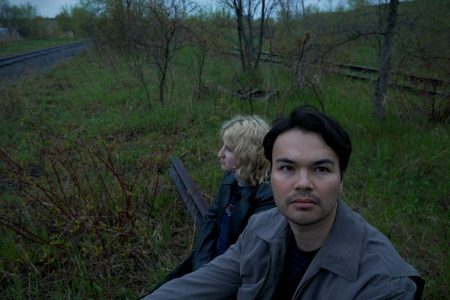
Sweeping Promises, the Lawrence, Kansas duo of Lira Mondal and Caufield Schnug, released their fantastic new album, You Say I Romanticize, via Sub Pop back in August of this year. Written over roughly a year of tracking and re-tracking more than 20 songs before cutting them down to 10, the record is shaped by seclusion, from the medieval anchoress Julian of Norwich to a creative climate the band describes as “under siege.” Ahead of a set in Boise, Idaho, I sat down with Mondal and Schnug to talk about the album’s unlikely inspirations, including a Wikipedia rabbit hole, a Mexican free-tailed bat colony, and an episode of The Sopranos. We also discussed the surveillance state, AI and authorship, and their deliberately unpolished approach to recording.
Northern Transmissions: There’s a track on the record, “My Anchoress”, which has a unique backstory. I was wondering if you can expand on that for those who might not know.
Lira Mondal: So, to give you the full backstory, it was one of those 20-minute wonders that Caufield and I try to come up with where, when we’re songwriting, we try to come up with an idea fully formed in 20 minutes or less; otherwise we’ll abandon it. So, we had everything but the lyrics for this. And Caufield went on this Wikipedia rabbit hole and discovered Julian of Norwich, who is an anchoress. You want to explain what that is?
Caufield Schnug: Well, that’s someone, a woman, in her case, who sequestered herself voluntarily in the basement of a church. She never went outside. She was like an anchor being dragged by the church, so that was one way that she could dedicate her life to letters as a woman not from a priestly or noble class. She wrote Revelations of Divine Love, which is like an intense and radiant religious text that is learned, but also apocalyptic in a lot of ways.
LM: And born out of hallucinations! Born from a night of feverish, divine illusion. It’s very sensuous.
CS: Sometime during her life she decided to leave the basement and rejoin society, which she did for a few months, and then decided, “Not for me. I’m going back to the anchoress position.”
NT: What did you find in the idea of someone with that kind of background, who locks themselves away to write, that felt relevant to the rest of the record?
LM: We were very sympathetic to her because we were kind of doing the same thing. This was after Good Living and a lot of touring for Good Living, and it took us about a year of writing upwards of 20 songs, tracking them all, reformulating them, tracking them again, reformulating those, and third time’s the charm with this record, where we winnowed them down to 10. But I think we both felt very hermetic.
CS: I just think she’s really brave. It’s hard to lock yourself away to devote yourself to intensive letters. Say what you will about the projects, but she has a strong claim to being the first woman writer in English. There’s a creativity there, and I think this album is about writers and writing and its psychological aftereffects.
NT: You wrote 20-something songs for the record but eventually had to cut it down to 10. Was there any song that almost made the record, but you thought, “Maybe we should save that for later”?
LM: Half of them we ended up ditching. Well, “Cocoon,” actually. We attempted to put that on Good Living Is Coming for You, and that one ended up on the chopping block in favor of what eventually made that record, but we had been playing that song for years. It’s so funny, I think we tracked it eight times over the past couple of years, trying to get it just right tempo-wise and feel-wise. It was a Goldilocks situation, and I think we finally accomplished it.
CS: It’s the hardest song to capture because there’s barely anything there.
LM: It’s so naked, so minimal.
NT: I was also curious where the title of the record came from. It’s a unique phrase, but also accusatory, in a way.
CS: YOU say I romanticize, but I think I’m totally normal! My projections are in check. I think we liked that sort of candy-wrapper threat. The last album was Good Living Is Coming for You, and it’s a bourgeois optimization character that’s kind of-
LM: A shadow looming.
CS: It’s promising something that’s really a menace. I think this album, being about romanticization and projecting and wanting to picture a more creative world, a world where your imaginations can manifest, is something we hope for in a really basic way. But creativity is in a war-like state right now. It’s under siege. And I think you’re totally right about the accusatory thing.
LM: Directly, it’s a lyric from the very last song, “Write Lightly,” which is a summation of all of the themes that Caufield just elucidated. It’s very much a finger pointing back.
NT: I wanted to mention that song because I remember reading that it might have been loosely inspired by the database The Atlantic put out, where you can type in your band name and see what’s been used to train AI.
LM: That happened after the record was delivered. We only found out about it a few months ago, but it definitely ties in to some of the themes about the act of writing, and authorship more broadly, and how it can be weaponized against an individual or completely taken.
CS: The new forms of theft that accompany authorship, and the drive that people feel to author something. I’m sure “Write Lightly” is in the training set now, because Suno probably left no stone unturned when it came to our catalog. By the way, can’t wait to sue them to the Stone Age. F**king ponces.
NT: I love it. Caufield, I also remember reading that you call yourselves primitive amateur musicians, suspicious of anything that sounds too clean or formalized, but that you also went into this record with the mindset of making the best record you can. How do you balance that, keeping it raw enough without making it too clean production-wise?
CS: Maybe I’ll speak just for myself here. I think Lira is a terrific musician, but when we embarked on making music together 17, 18 years ago, we weren’t too into the technical side and didn’t really want to improve. We wanted to be like primitive painters or something, and just be wild and free and not get too meta about technique. I think the same way about recording. I want it to be wild and free and capture room reflections-
LM: But be rigorous in other ways. I only just got a pedalboard for the three pedals that I use on my bass. So that’s the level we’re at.
CS: I think we wanted to make de-professionalized albums that didn’t sound perfectly manicured and domesticated, with all the frequencies in an expected place-
LM: Or easy to be put in the background. Like hotel paintings.
CS: Optimal stacked-containers stereo field. We wanted to make something that sounded crazy-
LM: But also engaging and catchy.
CS: In the early albums, I was explicitly thinking that if someone were to play this in a professional space, or even a coffee shop, I wanted it to be a bothersome nuisance, to disturb people’s priors just by the texture of how it sounds, or even how we play.
NT: The first song on the record, “Shooting Shadows,” I heard, also has a pretty interesting backstory.
LM: Very basically, it started off as a knee-jerk reaction to an episode of The Sopranos that we were watching, a moment when Tony Soprano is getting raided by the FBI. Then it took on a more immediate cadence, hearing about ICE’s activities picking up. Of course, this agency has existed for over 20 years, but the violence has ratcheted up in the past couple of years. It’s hard to ignore, and it’s hard not to let what’s happening in the world seep into what you make. So it became this impassioned outcry against the surveillance state and the hilariously clad Gestapo that we see falling over themselves trying to play vigilante god in the streets.
CS: Struggling in the snow.
LM: They can’t run very well, can they?
CS: No.
NT: Bouncing off of that, I heard there was another song on the record inspired by that, “Abduction on Camera.” Was there any hesitation about being that explicit on record, or was it more like, “No, we need to say this”?
LM: I still feel like we’re not incredibly explicit. “Abduction on Camera” also has an interesting backstory, where it morphed from a moment of enraptured awe at the natural world. It was inspired by witnessing millions upon millions of Mexican free-tailed bats emerge out of a cave, feeling this emanation of thousands and millions of lives whirling all around you out of this small, unsuspecting place, and just wanting to be a part of it, or even just to bear witness. Then flipping it on its side to bear witness to people being disappeared right before your eyes by the state. It’s that moment of accidental voyeurism, and how it can turn into a completely life-altering experience where you’re empathizing and wanting to escape at the same time.
CS: And the idea of the swarm, and deriving political strategies from bats, who use echolocation and always know where each other are, or are bumping into each other, and there are millions of them, and they live like communists in a cave together, upside down. There’s a little creative extrapolation there. But I think swarm thinking is another theme of the lyrics on this album.
LM: In our music, and also in this greater community, we are literally trying to put out feelers to like-minded people. I feel like that’s how we have to operate now. We’re all just trying to seek out sympathetic characters and gain strength from one another against the day-to-day horrors of this life, and also trying to find joy in that.
NT: I think that’s especially potent now, because there’s so much darkness around. Things like community, finding those like-minded people, are especially important.
LM: What’s the opposite of a dog whistle? A bat sonar.
Order You Say I Romanticize by Sweeping Promises HERE
Latest Reviews
Tracks

Advertisement
Join the Northern Transmissions insiders list
Sign up for reviews, interviews, news, videos, playlists — and more.