Matt Hitt Begins His Solo Career One Step At A Time

First emerging in the indie rock scene with Drowners, Matt Hitt hasn’t put out original music in almost ten years. That’s not to say the New York City-based Welsh indie rocker hasn’t been busy; much of the time in between has been dedicated to touring with The Vaccines, the UK group behind 2010s indie rock staples like English Graffiti (2015) and Combat Sports (2018). But, from his years of close collaboration with the band came an end to his hiatus, marked by his debut solo EP, You’ll Be Lucky, produced by Vaccines member Tim Lanham.
“I never stopped writing,” admitted Hitt, who Northern Transmissions sat down with in early December in New York City’s East Village. In fact, there’s a lot of material waiting to be shared; from our conversation, it seemed as though the artist is more than ready to take ownership of it. You’ll Be Lucky was independently released on November 14 through Killphonic Records.
You’ll Be Lucky was independently released on November 14 through Killphonic Records. Seeing how this became the culmination of his years of experience in multiple bands. And what began as a conversation about his five new tracks turned into thoughtful reflection on the economics of production, releasing music in small bites, and the ever-inspiring character of New York City.
Northern Transmissions: I wanted to focus mainly on your EP that just came out only this year, and your new direction as a solo artist now. But first, to recap: last night, you had a performance at Baby’s [All Right, NYC]. How’d that go? How is being the frontman of your own solo project live?
Matt Hitt: I think the show went well, or at least I came away thinking I didn’t fuck up. That’s my minimum requirement for me to think it was good. But I did notice an absence on the stage. Well, I played with a drummer, but then it was just me. It’s weird. Actually, the weirdest thing was walking in, your name’s written on the wall instead of a band name. It feels intrusive, and I thought, “Shit, I should have come up with a moniker!” It’s…lonely? I mean, there’s not much else to look at if you’re watching the show, and so it felt intimidating. But, I think it was good.
NT: Right, you’ve always been in bands up until this point. There was Drowners, which you started ten-ish years ago and fronted, and later you joined The Vaccines as a touring guitarist. How have both of them informed the way that you were going to take your solo project, and the way that you were going to approach composition and songwriting?
MH: When Drowners went into a sort-of hiatus, I carried on writing songs anyway, as I had done for that band. Then there were a few years before I joined Vaccines, but with Drowners was how I learned to write songs. It was my first foray into it. Vaccines operate on this pro level, where I learned a lot about what works and where you can afford simplicity. You know, I’m not in the front of the stage with the Vaccines, so I can kind of observe what’s happening, which is a vantage point I enjoy, probably sometimes more than standing at the front of the stage. But The Vaccines have taught me a lot about how things work in terms of the job. Drowners was basically like a DIY punk version; like, we only ever toured in vans, shared one hotel room, and that kind of thing. So yeah, ‘punk versus professionalism’ is what I learned from both those things.
NT: To be fair, with Drowners, you were basically a teenager when you started that band.
MH: Well, I looked like one, but I was 23.
NT: That’s practically a teenager!
MH: Yeah, yeah, yeah. I was very young. Also like, at that age, it was fun to just tour in a van.
NT: Yeah, that’s the age where you can do horrible things to your body and be fine the next day.
MH: Exactly, yeah! Like, only eating at gas stations and sharing a bed with four people. That’s a part of it; it’s fun. Although, now that I’m older, I do enjoy the more comfortable style of touring with The Vaccines. Even being around them is inspiring because they have their own side projects and stuff. They have a really creative outlook that made me want to really share my own music again. I never stopped writing; I just stopped putting it out until now.

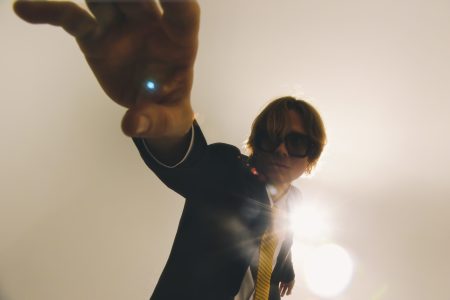
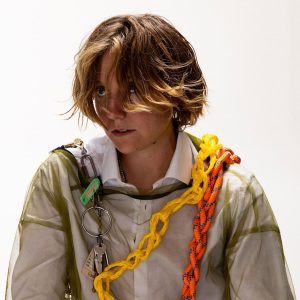
Matt Hitt by Bobby Nicholas III
NT: Expand on “affording simplicity.” I feel like that ties neatly into the sound of your EP and how it feels very classic indie rock and roll: guitar heavy, not much electronics, which goes against what a lot of other rock bands seem to be doing these days…What was your mode of thinking before going for that classic, good guitar?
MH: It’s funny you say that because I feel like we were going for the opposite. The things that sound like guitars on the EP, this is intentional. There are a lot of things that sound like guitars that aren’t guitars.
NT: Are they synthesized?
MH: Yes! There’s a lot of synth stuff on there. But also, with the songwriting, when you start doing it, there’s like, a spine to it. No matter what genre you do, this sort of spine of the writing is still in it. So, I don’t think I’ll ever be able to get away from indie rock.
To your original point, I made the EP with Tim Lanham, who plays guitar for The Vaccines, and he’s a whiz. We basically did the classic thing of deleting whatever doesn’t need to be there. And that’s where the simplicity of it comes from. A lot of it is a product of having to be economical anyway. Like, last night when I played with just a drummer, that’s basically in order to be economical. Even in the recording of it, we would do it in little gaps in between the tours, like a day at a time. So it ended up taking six months to record because we would do one day every three weeks or something. Just being economical is how it ended up being simple, but I kind of like that. It’s like, if you’re like, “Okay, we’re only using these sounds,” then you have to maximize or invent ways of using that. This is going to sound very pretentious, but it’s like, if a painter says, “I’m only using blue and yellow in this painting,” you have to come up with ways to make it imaginative with a small palette and canvas.
Continuing with the production, I think that it was a subtle trick, but I found it really interesting. Throughout the EP, it kind of sounds like you’re singing through a fan or an old-timey radio. What was the thought process behind that tinny, echoey sound? The first song we recorded was “I’m Sorry, New York”, and the general idea we had going into it was to imagine an orchestra from the future playing it. So, instead of woodwind instruments, for example, it’s like weird, loopy slide whistles or whatever. With that instrumentation, then, clean vocals stood at odds with it, at least to me. So, we tried to make the vocals a part of this futuristic orchestra. There’s a little buzzing that’s pretty overdrawn; the whole thing is hot, electrically speaking. I did it mainly so it could fit in with that initial vision of trying to make futuristic orchestra music.
NT: At least to me, the buzzing also has a retro aspect to it, especially in “I’m Sorry, New York”, which takes on this melodramatic, lounge-y tone with its big sound and sweeping emotions. You’ve lived in New York for 10-11 years at this point, and now you’re making this EP that reads as very centered on that experience of living here, of seeing how the city’s changed throughout. Has that shaped the way you think of our music scene, what the “New York” sound is, and how best to capture it in lyrics?
MH: I feel like Drowners, as it was, was pretty New York-y as well, mostly because the band started here. But I was also so young and excited about everything. A post-pandemic New York, in combination with getting older, hasn’t made me a grumpy old man, but I do feel sort of weathered by it now. I feel like I used to be in awe of it, and now I feel like I go through waves. Sometimes it’s bogging me down, and it’s really hard to be here. Other times, it can be one warm day and you’re like, “This is the best fucking place on Earth!” So, I feel like I’ve got more of a spectrum view of the whole experience of living here.
I wrote the song — it’s actually the oldest one on the EP, as I wrote it maybe three years ago and right before I joined The Vaccines. Then, I left New York for about a year and a half for the tour, which is the longest I’ve ever left since I moved here. When I came back, I fell back in love with it. It’s sort of like…You know when you go out with someone, and you really fancy them, but then they do something that gets on your nerves? That’s what New York’s like to me.
I’ve been here for almost 10 years, and my relationship with it has always been like, “You don’t know how to be a city; nothing ever makes sense. You’re the worst city in the world, but I can’t live anywhere else.” But then, as you said, you have one good night out, and you’re like, “This is the greatest place ever!”
You get spoiled living here, and you don’t even realize that! I mean, the fact that we’re just talking about it for ages as though it’s his own entity sheds light on the fact that it’s not fixed whatsoever. Like, the fact that it never sits still means there’s always something to talk about. It’s endlessly fascinating, whether the trains are really fucking annoying and broken, and it seems like everyone else here is richer than you, but then you can drink free champagne at some weird party. All of that can happen in an evening, which is pretty rare. I don’t think that happens anywhere else. It definitely doesn’t happen in London or LA. I just love it, even though it pisses me off.
NT: I wanted to go through each song and how You’ll Be Lucky came together — where each song fits, how you wanted to begin your solo career, etc. Because you’ve been writing a lot of songs for a long while.
MH: “Carried Away” is the first one. A lot of times when I write songs, I’m like, “Okay, I wanted to have this drum beat that’s sort of…krautrock. I want to write one like that.” At the time, I was listening to “As It Was”, that Harry Styles song, which has this repetitive drumbeat. So I was like, “I’ll try and write one that’s like that!” Obviously, I didn’t create the exact same one, but the song’s got a similar, excited loop. Plus, unless you’re in the mood to listen to that kind of krautrock thing, that kind of beat becomes pretty anxiety inducing. The whole song’s basically about anxiety and a need for reassurance through change and mess.
NT: And cutting your hair in the sink?
MH: Well, I’ve been cutting my own hair for like, 10 years, so that bit’s true. I added it because I was thinking about that anxiety thing and going down the rabbit hole of when you find yourself worried, like, “Oh, does everyone hate me?” or whatever. And combining that with words of reassurance you might hear if you’re on, like, a mushroom trip or something. It’s basically a mash of that: of being worried, going down your own mental rabbit hole, setting it through the lens of a mushroom trip to a drumbeat I stole from Harry Styles. Yeah. There’s one particular lyric, “You measured out your life / By how many summers you had left to try”, I included because the Drowners guitarist, Jack Ridley, always used to say that. He’d be like, “Well, I reckon I got about 30 summers left!” That’s pretty macabre.
NT: Yeah, very goth T.S. Eliot.
MH: I was going to say it’s definitely riffing off “measure out my life in coffee spoons” from [The Love Song of J. Alfred] Prufrock, yeah. Mine’s a sort of a mix of the coffee spoons and Jack Ridley saying, “I got 30 summers left.”
NT: And though we talked a bit about it already, what about “I’m Sorry, New York”?
MH: That one was the first song I wrote intentionally for a solo record. I don’t want to say it’s autobiographical because it’s an imaginary scenario, but I tried to cover all the bases of the things that were me. You know, it had to have a Welsh reference, and I wanted to just make it like a true experience in New York. I didn’t want to make a song that’s just like, going out, partying, and saying everything’s fucking awesome. I don’t know if I ever wrote the word “Tonight”, but I really hope not. The song’s sort of written as if New York was my girlfriend, and I was talking about how awesome it is and how annoying it can be. It’s sort of a love song and a breakup song, all in the same tune. It’s also inspired by a Jarvis Cocker thing I read where he wanted to write “Babies” using only two or three chords. So, I basically wrote four chords and tried to make a whole song out of it.
I guess the commonality throughout the EP is that I set a task for myself like, “Oh, I want to make a song like this!” and then produce it musically. Lyrically. I try and challenge myself to write a bunch of things and then edit it down so that it fits into the three melodies. With the next one “Ladies of Lucille Avenue”, I had a similar challenge where I wanted one song in a minor key because everything else was in major. Lyrically, I was trying to make it sort of druggy as well — not long but surreal.
NT: And then “Am I Supposed To Forget About You”. That’s the next one, right?
MH: Yeah. That one started as an acoustic song where I was listening to these old Bob Dylan songs — and there’s a word for it in poetry as well — where the first line and the last line are the same, forming a tight loop. I was trying to write a folk song which had that title as the first line, last line, and refrain. But, then I showed it to Tim and he was like, “Oh, we should make it with buzzy synths!” We basically took the acoustic guitar out of it and then turned it into what it is now. But yeah, that was my attempt at writing a folk song.
The last one is “Kentucky Mules”. Again, I was trying to challenge myself to write a laid back, plodding song…Actually, this one might have been the “As It Was” song because it’s also got that rapid drum. Well, maybe it was true of both “Carried Away” and “Mules”. So I think that was my attempt at writing “As It Was”.
NT: Taking that all into mind, did you go into the EP on an individual challenge level — a kind of “testing the limits” or whatever — or is this sound you’re crafting going to be a part of a bigger project like a debut album?
MH: The EP thing was an economical decision because we only had time to record a certain number of songs. I feel like since I put out “On Desires” with Drowners, I was looking at new artists, and everyone seemed to just do a couple of EPs and then a record.
NT: Yeah, I’ve noticed that a lot of indie bands just starting out have been doing that recently. Westside Cowboy came immediately to mind, as did a bunch of other Brits in that circle.
MH: I was thinking of Gracie Abrams and Sombr doing that kind of thing. I think it’s more of a reflection of how people consume music nowadays, focusing so much on keeping listeners’ attention. It’s like, if I’m starting something new — a band, a solo project, a side project, whatever — I’ll make it smaller and digestible. So my next project will probably be an EP as well, and then I’ll do the album. I just wanted to put something out as quickly as possible and record it as quickly as possible, which meant recording half the number of songs.
NT: Could you expand on what you mean by “the way people consume”? Why would they prefer an EP?
MH: This is going to make me sound like an old man again, but there’s a sort of social media way music works now. If I put a song out, and then an EP, and then another song and another EP out very quickly, people can digest one song or five songs at a time. Whereas, you’re putting all this effort into making a record and then if it comes out on a Friday, by Monday, people have forgotten about it. Then there’s like 12 songs you’ve just put out that just sit there. I thought as an introduction, I’d rather have more coming out consistently than just one bulk item that gets forgotten about. And I feel like talking to my musician friends, they feel similarly where you’ve just got to put out a smaller number of things.

Matt Hitt by Bobby Nicholas III
NT: Obviously, there’s an appetite for records; music lovers, critics…basically people like you and me love records. But, I think if you’re starting something new, it’s hard to capture someone’s attention. And I think this has also only been happening in the last 10 years.
MH: Right, it’s a direct result of streaming becoming the main form of music consumption. Yeah. The decision to start with an EP was basically a result of anticipating how people would listen to it and the amount of time I had to record. It’s boring to admit it’s all practicality, which unfortunately is part of being a musician. Tim Lanham, who produced the EP, has his own solo project called T Truman. I talked to him a lot about putting stuff out, and we had similar complaints like, “You’ve got to push this one song really hard. You’ve gotta make a ton of videos, chop your song into sharable bits of audio…” It eats into how people would traditionally release music, which I think is unfortunate. A lot of artists, at least to me, have this very idealistic point of view of the traditional album.
NT: It’s the famous “The album is God” mentality Jack Antonoff proposed, or whatever.
MH: Well, that’s alright for him to say. He’s got seven million album credits and is sitting on the Taylor Swift royalties. But, to be explicit about the actual life of a musician who’s not Jack Antonoff or a top-tier pop star, it costs X amount of money to record something. It takes X amount of time, and you have to hire X amount of people. On top of that, I don’t have a rehearsal space in New York anymore. I gave mine up over COVID. Even paying for rehearsals and all this stuff…If I see a band play, and even if I don’t like the music, I still think these guys should be applauded. Because you got four people in the same room to play the same songs, bring their equipment, and they would have met up before to rehearse it. The amount of effort that goes into that is applaudable. Okay, now I do sound like a grumpy old man.
No, it’s genuinely just the state of modern times, I suppose. The laptop killed musicianship to a degree, but that doesn’t mean people aren’t doing something interesting. There’s this one musician [Rubber Band Gun] whose goal in life is to make 100 albums or something. He doesn’t even think of a concept for each one, he just puts out songs in batches determined by the order he writes, records, and mixes them. I think that’s just what streaming pushes creative people to do: work within a model where nothing’s really precious or contained anymore.
I mean, that idea is really cool. There are new things that have come out of this change. But…I don’t think I want to release every song I ever write. A lot of them are embarrassing. It feels a lot like treading water when you put something out. You need to make sure you get your head above the water, and in order to do that, you’ve got to keep putting out a lot of stuff, which means, you know, two EPs over six months instead of a one album over a year. It seems like the best way to do it now. Whether it is or not eventually, I don’t know. I’ll tell you when my bank account looks like Jack Antonoff’s.
NT: But also, I guess to think about this more positively, does sharing fewer songs at a time allow for flexibility? Does it influence the way you’d approach your songs for the next one and how you want your music to evolve over time?
MH: I don’t know because honestly, there’s a backlog of material. Things that would be on my next release, I’ve already written. I don’t know if I can think that far forward enough for it to have a purposeful evolution. I think maybe that just happens naturally. But it definitely affords you the chance to show who you are on a wider range. I like the idea that if all people have are five songs, and that’s all they’ll have until it’s the next time to put something out, then that encourages the songs to be better. It’s better that people pay more attention if you were saying something short but important rather than pay less attention to a lot of things.
I’m just excited to be putting music out again. I feel I haven’t done it for so long, and now that the ball’s rolling, it’s easier to keep doing it. I just hope people listen to You’ll Be Lucky; that was my only goal. Otherwise, I would have just kept these songs to myself in my bedroom the whole time.
Photography by Bobby Nicholas Ⅲ
Latest Reviews


Trending
Tracks
Advertisement
Join the Northern Transmissions insiders list
Sign up for reviews, interviews, news, videos, playlists — and more.